This article breaks down a vertical YouTube Short made with Seedance 2.5, together with the reference clip it was built from. In a pastel kitchen a woman with purple braids carries a tray of eggs while a black-haired man drinks water at the table. One egg rolls off the table edge, and the two of them spend the rest of the Short keeping it in the air in slow motion — a dive, a volley, a spike — until, in the last prompt set, a raw egg lands on his face. The creator kept a complete working document, and every prompt from it is reproduced below, ready to copy. The source document is written in Chinese; the English versions keep its structure, camera directions and timing. Each prompt assumes the kitchen reference image is attached.
The document records about 520,000 views for the version with a dog added. That is one case-study result, not a promise that the same prompts will go viral. What is worth copying is this article's order of work: tear the reference Short down frame by frame, build one reference image, then generate 15 seconds of slow-motion action at a time and cut the best takes together.
Watch the 520K-view Short on YouTube · the clip the document tears down frame by frame
Pipeline overview
- Frame-by-frame teardown: watch the reference Short and write down what happens in every beat, down to the frame.
- One reference image: build the kitchen with both characters, the tray of eggs and the single egg at the table edge.
- Timed prompts: three 15-second clips, written as seconds, camera, action and expression — with slow motion stated in almost every beat.
- Generate and pick: the document warns that the action is too dense for one clean take, so draw several takes of each prompt and re-edit.
- Edit: cut the best takes together. Every prompt asks for rich sound effects but no background music and no subtitles; music and captions belong in the edit.
1. Watch the reference Short frame by frame
The document opens by tearing the reference video down to the frame rather than starting from a prompt. Nearly everything that matters in the prompts below comes from this shot list: the camera switches four times inside the first four seconds, then the action stays in slow motion for the rest of the Short.
Setup: four camera angles on one falling egg (0s–4s)
- 0s00f–1s10f — eye-level medium shot. A cuts her own snack at the table; an egg on the table rolls toward the table edge.
- 1s10f–2s00f — cut to a side view. The exact moment the egg leaves the table edge.
- 2s00f–2s26f — cut to a low angle from the floor, looking up. The egg falling through the air, and A's astonished face.
- 2s26f–4s08f — cut to a top-down view. The egg keeps falling toward the floor.
B's dive and the first bounce (4s–12s)
- 4s08f–8s11f — the dive. B, two metres away, is carrying a tray of eggs in both hands. He sees the falling egg, his eyes go wide, and without thinking he throws the tray of eggs up into the air and dives after the falling egg to save it.
- 8s11f–11s06f — the catch. B lands flat on the floor, both arms stretched forward; his right hand catches the falling egg and bounces it back up into the sky.
- 11s06f–12s08f — the camera is on the egg bouncing up into the sky.
The rally: A and B keep the egg in the air (12s–22s)
- 12s08f–13s26f — A reacts. Her expression is tense and astonished, mouth wide open, eyes on the sky. She turns her head from left to right watching the egg fly, then dives in the direction the egg is travelling.
- 13s26f–16s05f — A moves along the floor until she is under the egg's position in the sky, then jumps up with both arms reaching for it.
- 16s05f–17s19f — the second save. A jumps and pushes the falling egg back up into the sky with both hands.
- 17s19f–19s22f — two people, two levels. Wide shot: A jumping and pushing the egg with both hands. Near shot: B climbs from the chair onto the table, trying to hit the egg toward the target from up high.
- 19s22f–20s22f — A's face, close. Eyes wide, mouth wide open — she seems to be telling B to keep going.
- 20s22f–22s22f — the hit. B jumps from the table and hits the egg in the sky with his right hand, sending it forward.
The pan and the thumbs-up (22s–31s)
- 22s22f–23s26f — A grabs a frying pan from the table and tries to catch the descending egg in it.
- 23s26f–25s03f — side view of the same hit. B jumps from the table, hits the egg in the sky with his right hand and sends it forward.
- 25s03f–26s03f — the slide. A holds the pan in both hands and slides forward on her knees; in the distance B jumps from the table and hits the egg with his right hand.
- 26s03f–28s03f — top-down on the pan. A holds the pan, eyes wide, mouth open, a thrilling expression on her face. The camera pushes in, then cuts to a close-up of the pan.
- 28s03f–31s17f — the catch and the thumbs-up. The egg lands in the pan. A raises her right thumb, happy.
The document's own reading of the reference is the useful part: four camera setups inside the first four seconds, then one continuous slow-motion rally for the remaining twenty-seven. That contrast is the whole trick, and it is what the prompts below reproduce.
2. Build the one reference image
This is where the document differs from an ordinary prompt list: the entire Short runs on a single reference image. The document says the image was tuned little by little in aiMakeVideo — moving the egg, moving the characters — and that this one image is the only reference for all three clips below. It also states the count plainly: three prompt sets, one reference image.
Model note: the document says the reference image was tuned with "bananpro", which is Nano Banana Pro, one of the image models in aiMakeVideo. It was tuned a little at a time — the egg's position, the characters' positions — rather than generated in one go.
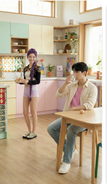
It is a 9:16 kitchen scene. The purple-braid woman stands on the left holding a tray of eggs; the black-haired man sits at the table on the right drinking water; one egg sits at the table edge between them. Two things are worth copying from the way the document treats it:
- Both characters are in frame from the start. Every clip needs her, him and the egg, so the reference has to establish all three at once — and the prompts then work to keep the wrong one out of individual shots.
- The egg and the poses are what got iterated. The document spent its rounds on one small object and one small pose, not on the room. A reference image is cheap to fix and expensive to re-shoot, so fix it before you generate video.
If you build your own, keep the same shape: one room, two people, one small object that is going to fly.
3. Prompt set 1: the egg rolls off the table
The first set opens on the reference image and takes the story to the first mid-air save. The first line of every set in the document says who is who in the reference, because one image carries both characters.
Is the purple-braid woman, is the black-haired man.
[0-2s] Reference.
The black-haired man sits on the chair drinking water; the woman carries a tray of eggs and is slowly walking toward the counter top in front of her; the camera focuses on the single egg on the dining table, which is rolling toward the table edge and has just dropped off the table.
[3-5s] The instant the egg rolls off the table and drops, the picture enters slow motion: a low-angle close-up from the floor shows the egg falling through mid-air in slow motion. While the low-angle close-up holds on the egg, the black-haired man must watch the egg's slow-motion fall in extreme panic.
[6-9s] The purple-braid woman looks toward the front of the camera in extreme anxiety and panic; she throws the plate in her hands and the eggs on it hard into the air behind her. The picture enters slow motion; the eggs scatter in mid-air behind the woman; the purple-braid woman dives forward toward the front of the camera in slow motion, anxious and terrified.
[10-12s] Slow motion, shot from a ground-level point of view. A slow-motion shot of the purple-braid woman: she lies on the floor and slides toward the camera; in the background some out-of-focus eggs are falling in slow motion and smashing on the floor behind her. She looks up in utter terror at one egg in the upper foreground that is falling toward the ground, and she reaches one hand out along the floor, palm up, trying to catch the egg falling from the air.
[13-15s] Slow motion. The egg drops into the woman's hand; she pushes upward hard but does not hold it — the egg is pushed high and flies up out of frame above the camera. The woman must keep watching the egg in utter terror, and only this one egg may appear in the picture.
Rich sound effects, no background music, no subtitles.
4. Prompt set 2: the man's run and the first volley
The second set is almost entirely the man, and it is where the document's negative constraints do the heaviest work: three beats in a row end with "the woman must not appear in the picture", because the single reference image contains her.
Is the purple-braid woman, is the black-haired man.
[0-1s] Reference.
Close-up of the man's chest and head. In extreme panic his gaze moves slowly in slow motion from the upper right to the upper left, and as he looks he slowly spits the water in his mouth out in slow motion. The woman must not appear in the picture.
[4-7s] Slow-motion shot of the man's upper body. Side-on to the camera, he takes two quick steps toward the edge of the frame, turning his head as he runs to look up above the camera in extreme panic, then he jumps hard in slow motion with both hands raised in a lifting motion. The woman must not appear in the picture.
[8-11s] Slow motion, close-up of the man as he jumps in mid-air in slow motion with both hands raised in a lifting motion. An egg is flying from the air toward the man's hands; he pushes up hard but does not catch the egg and sends it high up, out of frame above the picture. The woman must not appear in the picture.
[12-15s] Slow motion. In the background the man makes the lifting motion, watching an egg above him in anxious panic as it slowly flies up into the air. Side shot of the woman: in the foreground she stands on the chair, looking toward the egg in the sky with her back to the camera, knees bent and loading to jump. There is no egg on the table at this moment.
Rich sound effects, no background music, no subtitles.
5. Prompt set 3: the spike, the bowl and the face
The last set is the busiest of the three: the woman spikes the egg downward like a volleyball, the man slides in on his knees with a big bowl to catch it, and the document then ends the rally on a gag instead of a clean catch.
Is the purple-braid woman, is the black-haired man.
[0-2s] Reference.
Slow motion, low-angle shot. In extreme anxiety and panic the woman stands on the dining chair that the man sits on in the reference image, looking up above the camera; she loads and jumps high, reaching out one hand in the pose of a volleyball spike. The black-haired man must not be in this shot.
[3-5s] Slow motion, shot of the black-haired man. In the corner of the reference image, in utter anxious panic, he looks up above the camera and runs toward the camera, pulling a big bowl out from behind him at the same time, running in slow motion toward the camera and out at the edge of the picture, anxious.
[6-8s] Slow motion, side shot of the woman in mid-air in a spike pose, her face full of anxious panic. An egg is flying slowly from above her shoulder toward the front of her hand; with one slow-motion spike she hits the egg and sends it flying down and out of the picture at a diagonal. The egg must not be broken by her hit.
[9-10s] Slow motion, high-angle follow shot of the black-haired man sliding toward the camera on his knees, his weight leaning back, holding a big bowl in both hands with the bowl facing up in front of him, ready to catch something.
[11-12s] Over-the-shoulder view of the man, slow motion. His weight leans back as he slides toward the woman on his knees, holding the big bowl in both hands in front of his chest ready to catch the egg; the woman is falling from mid-air in utter terror watching the egg; an egg is flying slowly through the air toward the man.
[13-15s] Slow motion, slightly high-angle follow shot of the man sliding on the floor toward the camera, his weight leaning back, his expression going slowly from anxious panic to happy, looking up above the camera, holding the big bowl in both hands in front of his chest as if he wants to catch something. The slow motion ends: a raw egg smashes hard onto the black-haired man's face, the egg breaks and the yolk and white cover his face; the man freezes for a moment, then a close-up of his face as he breaks down and screams.
Rich sound effects, no background music, no subtitles.
6. The dog remix behind the 520,000 views
The document ends with one line about the version that took off: on top of the AI video prompts above, a dog was added to make the scene more complex — 520,000 views.
The document does not include the rewritten prompts, so treat this as a sketch rather than a recipe. The consistent thing to do is what the document already does with the two characters: put the dog into the reference image first, then name it in every beat the way the purple-braid woman and the black-haired man are named, and give it one job in the rally (going for the egg) instead of leaving it as decoration. A dog that only sits in the background will not survive a 15-second shot.
How these prompts are written
- One reference image for all three clips. Every set therefore opens by naming who is who in it, and repeating the same reference instead of building new ones.
- Every beat names its camera. Low angle, side, top-down, over-the-shoulder, follow — plus shot size and movement. The document reads like a shot list, not a mood description.
- Slow motion is stated in almost every beat. With this much action packed into 15 seconds, slow motion is what makes it readable. It is the one stylistic instruction the document never leaves implicit.
- Negative constraints replace missing references. Because one image holds both characters, shots that only need one of them say so explicitly: "the woman must not appear in the picture", "the black-haired man must not be in this shot", "only this one egg may appear in the picture".
- Timelines in short beats. Each beat is 2–4 seconds and one event: camera, action, expression, and what the object does.
- Why you have to draw several takes. The document says it outright: there are too many actions, so you generate several takes and re-edit. Plan for it instead of expecting one prompt to land.
- The same closing line every time. Each set ends with rich sound effects, no background music, no subtitles.
Check these before you reproduce it
The source is a working note, and a few details do not line up. Settle them before generating:
- A and B are never named. The frame-by-frame teardown labels the two people A and B and stops there; the three prompt sets call them the purple-braid woman and the black-haired man. Read the teardown as a shot list and the prompt sets as the cast, and do not try to map A and B onto the prompts one for one.
- The prompts do not end like the reference video. The teardown ends with the egg landing in a frying pan and a cheerful thumbs-up. Prompt set 3 ends with a raw egg smashing onto the man's face and a scream. The prompt sets are a comedy remix, not a frame-accurate copy — pick the ending you want and write it into the last beat.
- The pan becomes a bowl. The teardown's frying pan is a big bowl in prompt set 3. Use one word in both places or the prop will drift between clips.
- Set 3 opens on an empty reference slot. The document writes
Reference []with nothing in the brackets, while sets 1 and 2 open with a plain "Reference". All three clips start from the same kitchen image, so fill that slot with it. - Set 1's last beat fights its own tray. [6-9s] throws a whole tray of eggs into the air, yet [13-15s] says only this one egg may appear in the picture. Keep the scattered eggs out of focus in the background, as the [10-12s] beat describes, and apply the "only this one egg" rule to the foreground.
- Timestamps restart in every set. [0-2s] in set 1 and [0-2s] in set 3 are different clips, not the same timeline. Generate each set as its own 15-second clip.
- The dog version has no prompts. The document records the change and the view count but not the rewritten text, so you will be writing that pass yourself.
- Recreate loads First Frame mode. The Recreate buttons put the kitchen image into Image to Video as the first frame of a 15-second Seedance 2.5 clip. Sets 2 and 3 cut away from that composition at once; if a take ignores their opening beat, try the All-in-one References mode in the Create studio instead.
Try it in aiMakeVideo
- Rough the kitchen scene out with Text to Image, place both characters and the egg, and tune them with Image to Image — the document used Nano Banana Pro — until the egg sits at the table edge and both people are in frame.
- Watch your reference Short frame by frame and write the shot list first — that is the step the document leads with.
- Press Recreate under a prompt set to load it into Image to Video with the kitchen image as the first frame, Seedance 2.5, 9:16 and 15 seconds, then press Generate. You can also paste a prompt in yourself.
- Draw several takes per set — video is billed per second, so check the credit cost in the composer before each run — then keep the best beat from each and cut them together. Trim the takes down to the beats so the rally reads as one continuous sequence.
- Add sound effects, music and captions in your editor. The prompts deliberately leave them out.
- If you want the more complex version, add the dog to the reference image and rewrite each beat to name it.
When you are ready, open the Create studio or read the prompt and model guide first. For the full character-and-keyframe workflow, see our other breakdown of making a YouTube Short with Seedance 2.5 on aiMakeVideo.